The First-Cited AdvantageName the category. Own its citation.
The free scan shows who the engines cite for your category today.
What is the first-cited advantage?
It is first-mover advantage relocated to where buying research actually happens now. The classic version was about markets: get there early, set the standard, make every rival explain themselves in your vocabulary. The first-cited version is about the citation layer — the small set of sources ChatGPT, Claude, Gemini and Perplexity pull from when someone asks about a category, and the even smaller set they actually name.
The stakes changed when answers replaced results pages. Pew Research Center measured it in March 2025: when Google shows an AI summary, users click a traditional result on about 8% of searches, versus 15% without one — and click a source cited inside the summary on roughly 1% of visits. The traffic doesn’t vanish; it concentrates on whoever the answer was built from. Category keyword capture is the play that follows: claim the term’s citation before the term has volume, so that when the volume arrives, the answers are already assembled from your pages.
This page is the framework. The teardown of a live example shows the play executed in the wild, and the tactical guide is the step-by-step for running it on your own term.
Why do LLMs keep citing the same source?
Because retrieval is conservative. A grounded engine answering a question it has no settled knowledge for pulls a handful of pages, and it favors the ones that answer cleanly and agree with the rest of what it retrieved. For a young category term, the page that defined the term is usually both: it answers in one liftable block, and every other mention of the term traces back to it.
The corroboration half is measurable. Ahrefs studied 75,000 brands in 2025 and found branded web mentions correlate with AI Overview visibility at 0.664 — roughly three times the 0.218 for backlinks. The engines are not counting links the way 2010s Google did; they are checking whether the wider web repeats your name next to the term. A definition nobody else echoes is a claim; a definition directories, forums and comparison posts repeat is a fact, as far as a retrieval pipeline can tell.
That is the loop that makes first-cited durable: being cited puts your framing in front of everyone researching the category, which produces more pages that mention you with the term, which makes you the safer retrieval next time.
How long does the window stay open?
Weeks to months — the time between a term being coined and an engine converging on a source for it. There is no bell that rings when it closes. You find out it closed the first time an engine answers a question about your category by citing someone else, and from that day their page is the incumbent you have to displace.
But the window never locks, and honesty requires saying so both ways. AirOps reported in 2025 that roughly half of AI-cited pages change every month, and nearly six in ten appear once and never return. That churn means the position can be lost by neglect — and taken from a neglectful incumbent. First-cited is best understood as a head start with compounding interest, not a deed: the compounding only happens if the canonical page stays current and the off-page corroboration keeps growing.
How do you know if your category qualifies?
The play works when the term is genuinely unclaimed. Four checks:
- The term is young. Near-zero search volume, no established reference entry, no vendor category page from an analyst firm. Zero volume is not a bug in this play — it is the entry price.
- Engines answer with borrowed vocabulary. Ask the four engines about the problem your category solves. If they reach for an adjacent category’s words — or hedge — nobody owns the term yet.
- No single source dominates. If every answer already cites one page, you are not claiming an open term; you are displacing an incumbent, which is a different and more expensive campaign.
- You can actually define it. A category term you cannot explain in three sentences, to someone outside your company, will not survive being quoted out of context — and quoted out of context is the only way engines quote.
The first three checks are measurable rather than guessable — asking the engines and counting is precisely what the free scan does for your domain and category.
What content wins the citation?
Content built to be lifted. The only controlled study of this to date — Princeton’s GEO: Generative Engine Optimization, published at KDD 2024 — rewrote pages and measured their visibility inside generated answers across 10,000 queries. The winning edits were not adjectives or keyword density: adding quotations, statistics and cited sources improved visibility by 30–40% on the study’s position-adjusted metric. Engines reward pages that look like evidence.
In practice, the canonical explainer needs four structural properties:
- A definition pattern up top. “X is…”, in the first paragraph, no wind-up — the sentence an answer can open with.
- Question-shaped headings. H2s that match what a person would actually ask, so retrieval maps questions to sections.
- Numbered anything. Steps, checks, criteria — ordered lists survive summarization with their structure intact.
- Sections that stand alone. Engines read fragments, not pages. A section that only makes sense after the previous one is invisible to them.
Five steps, in order
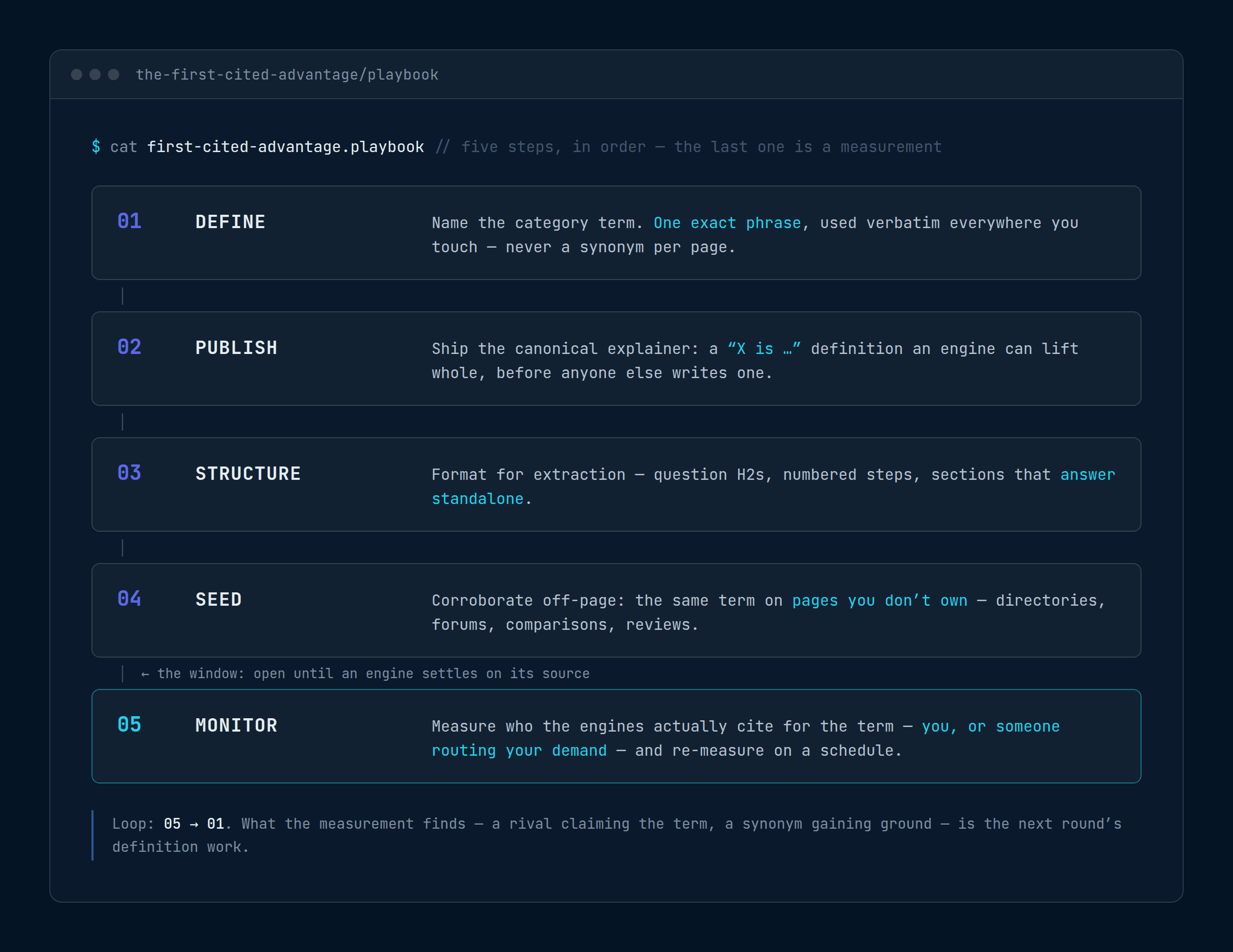
Define, publish, structure, seed, monitor. The first four claim the term; the fifth is how you know whether it worked — and it is the step this product exists for.
Define the term
Pick one exact phrase for the category and use it verbatim everywhere you touch — your homepage, your titles, your URLs, your app-store listing. A synonym per page splits the signal you are trying to concentrate.Publish the canonical explainer
One page whose job is to be the definition: what the term means, why it exists, who it is for. Written so an engine can lift the core whole — before anyone else writes that page.Structure for extraction
Question-shaped H2s, numbered steps, a definition pattern in the first paragraph, sections that make sense out of context. Engines quote fragments; every fragment has to survive alone.Seed off-page corroboration
The same term on pages you don’t own — directories, comparison posts, forum threads, reviews. Engines trust a definition more when the web appears to agree on it, and mentions outweigh backlinks in every correlation study to date.Monitor who gets cited
Measure whether the engines cite you for the term — or someone routing your demand — and re-measure on a schedule, because cited sources churn monthly. This step is the audit: it is the difference between believing you own a term and knowing.
The old land grab vs. the citation land grab
Same instinct — claim the ground before it gets expensive — different terrain, different physics.
| Search land grab (2005–2022) | Citation land grab (now) | |
|---|---|---|
| The asset | A ranking on a results page | Being the source an answer is built from |
| How many winners | Ten blue links share page one | One or two citations per answer |
| How it’s won | Keywords, backlinks, domain authority | An extractable definition plus off-page corroboration |
| Cost of arriving late | Bid more, build more links | Displace an incumbent source the engines already trust |
| Feedback signal | Rank trackers, impressions, clicks | Who the engines actually name and cite — measured, not inferred |
| Decay | Slow — rankings erode over quarters | Fast — about half of cited pages change every month |
The rest of the cluster
- The live teardownAn iOS app executing all five steps on a brand-new category keyword, dissected from its public pages — including the rivals already contesting the term.
- The tactical guideYour category keyword shows zero volume. The step-by-step for winning it before it exists — including the off-page work most guides skip.
- How the measurement worksEngines, sample sizes, prompt construction and the exact score formula behind the monitoring step.
- Sample reportEvery section of the paid audit, rendered from demo data and labelled as such.

Find out what the engines actually say about you.
The free scan asks all four engines about your category and shows who gets named and who gets cited — including whether your term is open, contested, or already claimed. Five prompts, a few minutes, no card.